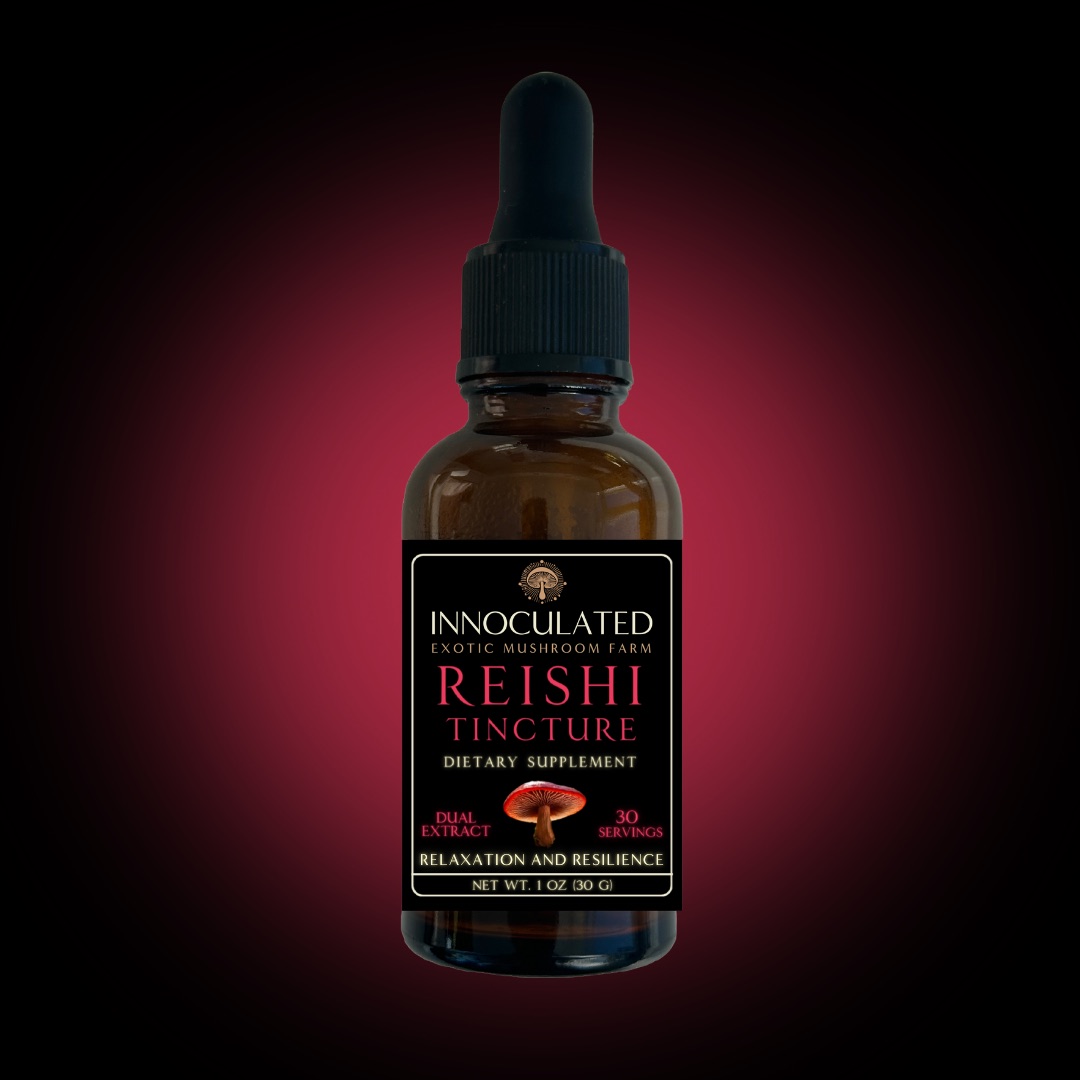
Reishi is the one mushroom on this farm that nobody asks for a recipe for. It is hard as a shoe sole, bitter enough to make you flinch, and it has been treasured for more than two thousand years anyway.
That contradiction is the whole story. Reishi was never food. It was medicine, then art, then a symbol, carved into imperial furniture, painted onto scrolls, and reserved in early Chinese texts for royalty. Understanding why it earned that status, and what modern research does and does not support, is more interesting than most things you can put in a pan.
What it actually is
Reishi is Ganoderma lucidum, a polypore, a shelf fungus that grows in brackets from hardwood rather than sprouting from soil on a stem. In the wild it fruits on dying or dead hardwood, favouring oak and hemlock, and it is genuinely uncommon; historical accounts of people searching mountains for years to find one were not entirely marketing.
A mature specimen is unmistakable. The cap is kidney- or fan-shaped, deep mahogany to blood red, and covered in a natural lacquer so glossy it looks varnished. The underside is not gilled but pored, thousands of tiny tubes, cream-white when fresh, that bruise brown at a touch.
Its names carry the reputation:
- Lingzhi (灵芝). Chinese, roughly “spirit plant” or “divine mushroom”
- Reishi (霊芝), the Japanese reading of the same characters, and the name that travelled west
- Mushroom of immortality, the honorific that appears throughout classical Chinese herbal literature
- Varnished conk, what a Western field guide will call it
The Shennong Ben Cao Jing, a Chinese materia medica compiled roughly two thousand years ago, places lingzhi in its highest class of substances: those taken over long periods for general vitality rather than for treating a specific complaint. That framing, a tonic, not a cure, has aged better than most ancient medical claims.
Why you cannot cook it
Reishi is technically edible in the sense that it will not hurt you. It is inedible in every sense that matters.
The texture is woody, not chewy, not tough, genuinely woody, closer to bark than to a portobello. A knife struggles. Your teeth would lose. And the flavour is aggressively bitter, a deep, lingering, resinous bitterness that dominates anything it touches.
This is not a defect. The bitterness is the active fraction. Reishi’s triterpenes, the compounds that most of the research is interested in, are bitter by their chemical nature, and a reishi with no bitterness is a reishi with very little in it. Growers use bitterness as an informal quality signal.
So reishi is prepared the way you would prepare a hard root or a bark: by extraction. You pull the compounds out and discard the wood.
Tincture, tea, or powder?
The three preparations are not interchangeable, and the difference comes down to solubility.
Reishi’s two main compound families dissolve in different things:
| Compound family | Dissolves in | What it is |
|---|---|---|
| Beta-glucans (polysaccharides) | Hot water | Long-chain sugars found in the cell walls of most fungi |
| Triterpenes (ganoderic acids) | Alcohol | Bitter resinous compounds, largely specific to reishi |
This is the single most useful fact about reishi, and most products ignore it.
- A hot-water decoction, simmering sliced reishi for one to two hours, extracts the beta-glucans well and the triterpenes barely at all. This is traditional reishi tea. It is bitter, but it is missing half the picture.
- An alcohol tincture alone extracts the triterpenes and leaves the beta-glucans behind.
- A dual extraction does both: an alcohol soak and a separate hot-water decoction, combined at the end. It is slower and more expensive, and it is the only method that captures the whole mushroom.
Ours is a dual extraction, which is why it is sold as a tincture in a dropper rather than as a powder in a jar.
Plain milled powder is the preparation to be most careful about. Ground raw reishi is ground raw wood, your digestive system cannot break down chitin efficiently, so a large share of what you swallow passes straight through. If a label says only “reishi powder” with no mention of extraction, you are largely buying sawdust.
If the label does not say “extract,” “dual-extracted,” or give an extraction ratio, assume nothing has been extracted.
What the research actually says
Reishi is among the most-studied medicinal fungi in the world, with thousands of published papers. That volume is genuinely impressive and also genuinely misleading, because most of it is laboratory work rather than human trials.
What is reasonably well established:
- Reishi’s beta-glucans are immunomodulating, they interact with receptors on immune cells in ways that are measurable and repeatable in the lab. “Modulating” is the correct word: they adjust immune signalling rather than simply boosting it.
- Triterpenes have demonstrated anti-inflammatory activity in cell and animal models, and they are the reason reishi behaves differently from other functional mushrooms.
- As a food-derived substance, it has a strong safety record across long-term traditional use.
What is not established:
- Human trials remain small, short, and frequently of poor methodological quality. Cochrane reviewers looking at reishi in cancer care concluded the evidence was insufficient to justify it as a primary treatment, a finding worth stating plainly.
- Sleep and stress claims, the most common reason people buy reishi today, rest largely on animal studies and a small number of modest human trials. The mechanism proposed is plausible. The human evidence is preliminary.
- Product variability is enormous. Species are misidentified, extraction is skipped, and one bottle’s contents may bear little relationship to another’s.
The honest summary: reishi is a legitimate object of scientific interest with real, characterised bioactive compounds and two millennia of traditional use behind it. It is not a proven treatment for anything, and anyone selling it as one is ahead of the science. We sell it as a traditional tonic, because that is what it is.
How to use it
Reishi is a slow one. Traditional use is measured in months, not doses, and people who take it report changes that are cumulative and subtle rather than immediate.
- Timing. Most people take reishi in the evening. It is not a stimulant, and the traditional framing associates it with settling rather than energising. It pairs naturally with a wind-down routine.
- How. A dropper of tincture straight, or stirred into a small amount of warm water or tea. It is bitter, that is correct and expected. Honey or a strong tea helps if the bitterness is too much at first.
- Consistency over quantity. Daily and modest beats occasional and heavy. Give it several weeks before deciding anything.
- Storage. A cool, dry place, cap closed. Ours is dual-extracted in alcohol and hot water, then carried in vegetable glycerine, so the finished tincture is alcohol-free.
Who should be careful
Reishi is generally well tolerated, but it is pharmacologically active and there are real interactions worth knowing:
- Anticoagulants and antiplatelet drugs. Reishi may have mild blood-thinning effects. If you take warfarin, clopidogrel, or similar, talk to your doctor first.
- Surgery. For the same reason, stop taking it at least two weeks before any scheduled procedure.
- Blood pressure and immunosuppressant medication. Reishi may interact with both. Anyone on immunosuppressants after a transplant should avoid it unless a doctor says otherwise.
- Pregnancy and breastfeeding. Not enough safety data exists. Skip it.
- Mild side effects, dry mouth, an upset stomach, occasional dizziness, are reported and usually fade.
None of this is unusual for a substance with real activity. It is, in fact, a sign that reishi is doing something. Treat it accordingly.
Where it fits
If Lion’s Mane is the mushroom you cook and Cordyceps is the one people reach for before a workout, reishi is the one at the end of the day. It is the least immediately gratifying of the functional mushrooms and the one with the deepest history, a tonic in the old sense of the word, taken steadily and quietly over a long stretch of time.
Two thousand years of people bothering with something this bitter is not proof of anything. But it is not nothing, either.
These statements have not been evaluated by the Food and Drug Administration. Nothing here is intended to diagnose, treat, cure, or prevent any disease. Mushrooms are food, not medicine, talk to your doctor before changing anything about how you manage your health.