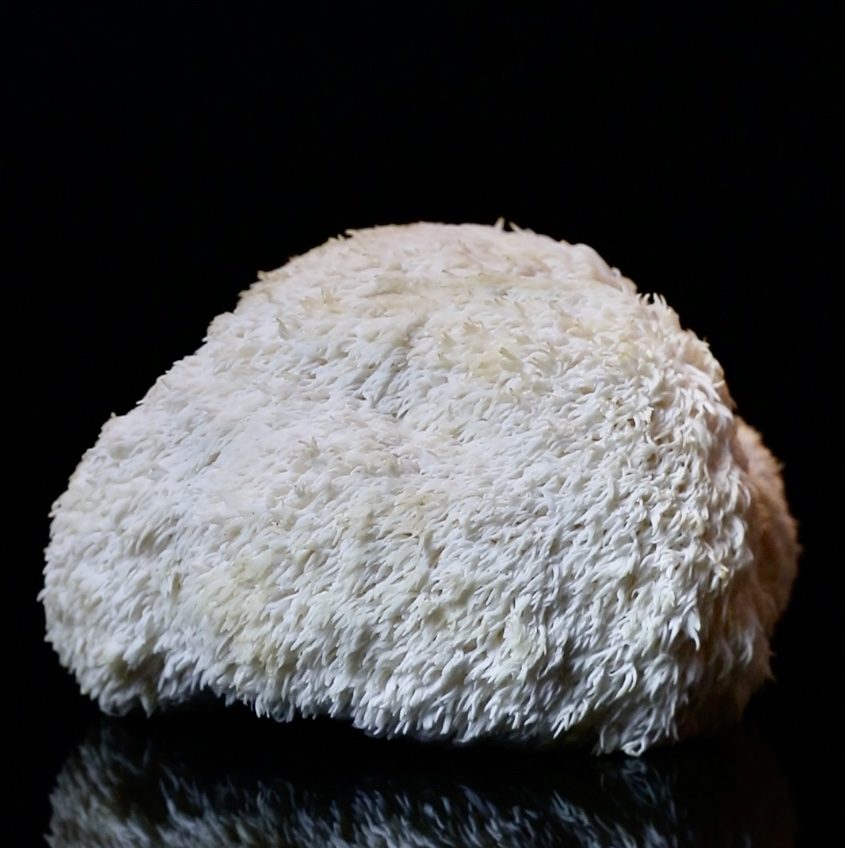
Lion’s Mane is the mushroom that converts skeptics. It does not look like food, it looks like a snowball someone left on a log, a white cascade of soft spines with no cap and no stem to speak of. Then you slice it thick, lay it in a hot pan with butter, and it browns into something with the sweetness of crab and the bite of a scallop.
It is also the variety people ask us about most, and for reasons that have nothing to do with dinner. Lion’s Mane has spent the last decade as the internet’s favourite “focus mushroom,” which means the honest version of this guide has to cover both the kitchen and the claims, including where the claims outrun the evidence.
What it actually is
Lion’s Mane is Hericium erinaceus, a wood-loving fungus native to hardwood forests across North America, Europe, and Asia. In the wild it fruits from wounds and scars high up on dying oak, beech, maple, and walnut, which is part of why foraged specimens are rare enough to be a genuine event.
It belongs to the tooth fungi rather than the gilled mushrooms. Where a shiitake drops spores from gills under a cap, Lion’s Mane grows its spore surface on those hanging white spines. No cap, no stem, no gills. Just a dense cushion of tissue and a beard of icicles.
You will see it sold under a pile of names, all the same organism:
- Lion’s Mane, the common English name
- Hou Tou Gu (猴头菇), “monkey head mushroom”. Chinese
- Yamabushitake (山伏茸), “mountain priest mushroom”. Japanese
- Bearded tooth or pom-pom mushroom, older field-guide names
The Japanese name is the evocative one. Yamabushi were mountain-dwelling ascetic monks whose robes carried long ornamental tassels; the mushroom’s spines were said to look like them.
What it tastes like
Sweet, delicate, faintly oceanic. The comparison everyone reaches for is crab or lobster, and it is a fair one, there is a shellfish quality to the sweetness that no other cultivated mushroom has.
Texture is the real prize. Raw, it is spongy and full of water. Cooked properly, the exterior takes a deep golden crust while the interior stays dense, fibrous, and faintly springy, closer to a seared scallop or a chicken thigh than to a mushroom. It shreds along the grain, which is why it works so well in “crab” cakes and pulled sandwiches.
Cooked badly, it is a wet sponge. The difference is entirely technique, and the technique is simple.
How to cook it
The single rule: get the water out before you add the fat.
Lion’s Mane is roughly 90% water and it will release all of it in the pan. Add butter too early and the mushroom steams in its own liquid, goes grey, and turns rubbery.
- Tear or slice thick. Half-inch slabs, cut across the cluster. Thinner than that and there is no interior left to stay tender.
- Dry pan first. Medium heat, no oil. Lay the pieces down and leave them. They will release water; let it hiss off. Three to four minutes a side.
- Press gently. A spatula, light pressure, once the surface is dry. This is optional but it improves the crust.
- Now add fat. Butter, a smashed garlic clove, a sprig of thyme. Two more minutes a side until deep gold.
- Salt at the end. Salting early pulls out more water and undoes step two.
Treat it like a scallop, not like a mushroom. Hot pan, dry surface, don’t crowd it, don’t move it around, salt last.
From there it goes anywhere a rich protein would: on toast with a runny egg, shredded into tacos, folded into a risotto at the last minute, or served whole as a “steak” with something sharp alongside to cut it, a lemon-caper butter, a salsa verde, a good mustard.
What it does not want is a long braise. The texture that makes it special collapses in liquid.
Buying and storing it
Fresh Lion’s Mane should be white to barely cream, dry to the touch, and firm when you press it. Walk away from anything with these signs:
- Yellowing or orange patches, the first stage of spoilage, and the flavour turns bitter well before the colour looks alarming
- Slick or tacky surface, moisture that has nowhere to go
- A sour or ammoniac smell, fresh Lion’s Mane smells faintly sweet and of almost nothing else
- Matted, collapsed spines, it has been sitting in a sealed container
Store it in a paper bag in the fridge, never plastic. Plastic traps the moisture the mushroom is constantly giving off and accelerates the yellowing. A paper bag lets it breathe and buys you five to seven days.
Do not wash it until you cook it, and even then, do not soak it. A dry brush or a barely damp cloth is enough. It absorbs water like a sponge, and every gram it takes on is a gram you have to cook back out.
How we grow it
Lion’s Mane is a hardwood decomposer, so the grow starts with hardwood. We fruit ours on supplemented sawdust blocks, oak and beech, hydrated, supplemented with bran for nitrogen, then sterilised and inoculated with grain spawn in front of a laminar flow hood.
The block spends two to three weeks in the dark at around 70°F while the mycelium colonises it completely. Then it moves to the fruiting room, where the conditions do the work:
| Condition | Target | Why it matters |
|---|---|---|
| Temperature | 60–68°F | Warmer pushes growth too fast and the spines stay stubby |
| Humidity | 85–92% | Below 85% the surface dries and cracks; above 95% it goes soft |
| Fresh air exchange | High | Too much CO₂ produces coral-like branching instead of a solid head |
| Light | Low, indirect | Lion’s Mane needs far less light than oysters |
Fruiting takes seven to ten days from the first pin. We harvest before the spines reach full length, a slightly young Lion’s Mane is denser, sweeter, and holds up better in the pan than a mature one, which starts to turn faintly bitter and shed spores.
Everything is cut the morning it ships. Nothing goes into cold storage, because cold storage is where the texture goes to die.
What the research actually says
Here is where we try to be more useful than the average supplement page.
Lion’s Mane contains two families of compounds that have genuinely interesting laboratory findings behind them. Hericenones, found in the fruiting body, and erinacines, found mainly in the mycelium. Both have been shown in vitro, meaning in cells in a dish, to stimulate the synthesis of nerve growth factor (NGF), a protein involved in the maintenance and repair of neurons.
That is a real finding, and it is the seed of every claim you have read.
What it is not is proof that eating Lion’s Mane improves your memory. The gap between “stimulates NGF in a petri dish” and “makes a human think more clearly” is enormous, and the human research that tries to bridge it is thin:
- The most-cited human trial is a 2009 Japanese study of 30 older adults with mild cognitive impairment, who scored better on a cognitive scale while taking Lion’s Mane and lost that advantage after stopping. Thirty people, sixteen weeks.
- A handful of small trials since have looked at mood, sleep quality, and mild anxiety, with mixed and modest results.
- Sample sizes are almost always under 100. Study lengths are almost always under six months. Several were funded by producers.
Meaningfully: most supplement research uses mycelium grown on grain, while what you cook is the fruiting body. The compound profiles are different. A study on one does not automatically transfer to the other.
The honest summary: Lion’s Mane is a promising subject of early research and a genuinely nutritious food, high in protein for a vegetable, a good source of potassium and B vitamins, low in calories, and rich in beta-glucans. Anyone telling you it is clinically proven to sharpen your mind is describing a study that has not been run yet.
Eat it because it is delicious. If the rest turns out to be true, that is a bonus.
Is it safe?
For most people, yes, it has a long history as food in East Asia and no established toxicity. Two real cautions:
- Mushroom allergies exist, and a few case reports describe skin and respiratory reactions to Lion’s Mane specifically. If you have reacted to other fungi, start small.
- It may have mild effects on blood sugar and blood clotting in animal studies. If you are diabetic, on anticoagulants, or heading into surgery, mention it to your doctor before taking concentrated extracts.
Culinary amounts of a fresh mushroom are a different proposition from daily concentrated extract, and the caution belongs mostly to the second.
Fresh or powder?
Both, honestly, for different jobs.
Fresh is the one to cook. It is the whole point of the variety, the texture, the crust, the crab sweetness. Nothing you can buy in a jar reproduces a properly seared slab of it.
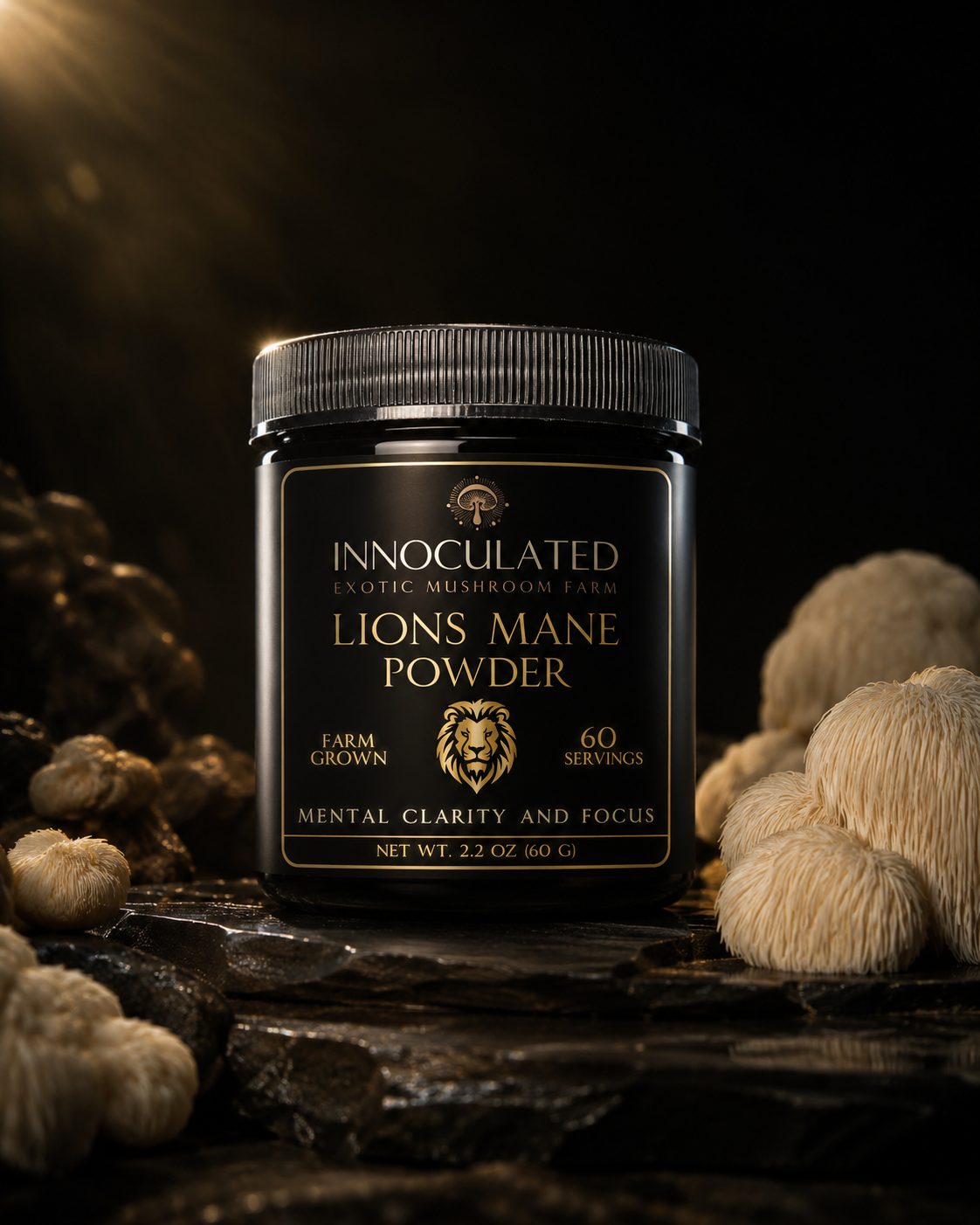
Powder is the one for consistency. It is dried fruiting body, milled fine, and it goes into coffee, smoothies, and broths without changing much about them. It is what people use when they want Lion’s Mane every morning without cooking at 7am.
If you have never had it, start fresh. Cook it once, properly, and you will understand what the fuss is about in a way no amount of reading gets you to.
These statements have not been evaluated by the Food and Drug Administration. Nothing here is intended to diagnose, treat, cure, or prevent any disease. Mushrooms are food, not medicine, talk to your doctor before changing anything about how you manage your health.